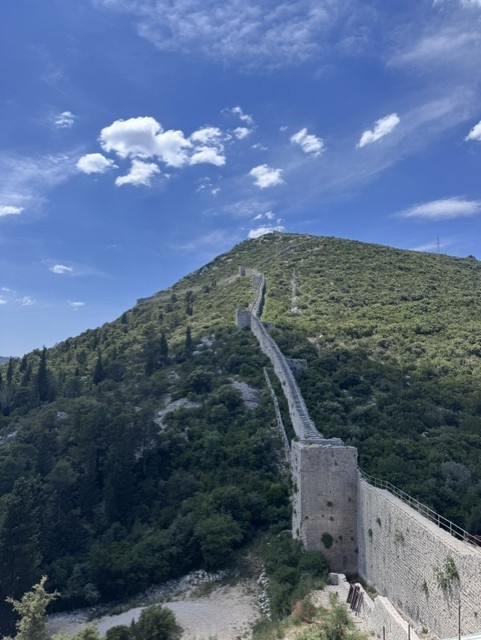
There is a small town on the Croatian coast called Ston, where the second-longest defensive walls in Europe climb across a ridge and run for kilometers down toward the sea. I walked them last week. They are extraordinary, and almost nobody outside the region knows they exist. The Republic of Ragusa built them, and rebuilt them, across centuries, at a cost that strained the resources of the small city-state that paid for them.
They were built to protect salt.
Not gold. Not silver. Not jewels. Salt pans, glittering white in the sun at the foot of the walls, worked since Roman times and inherited by the Ragusans from civilizations that had already come and gone before them. The walls were one generation's defense of an asset that earlier generations had created and that the Ragusans intended to pass on. They invested in stone what we would now invest in semiconductors, and for the same reason. They had studied their world carefully, and salt was what their world ran on.
It is worth remembering why. Before refrigeration, before industrial chemistry, before the global food trade, salt was the difference between surviving the winter and not surviving it. It preserved the meat slaughtered in November so a family could eat in March. It cured the fish that fed inland populations hundreds of miles from any coast. The Roman salarium, the payment to soldiers from which we get the word salary, was salt because salt was money. Wars were fought over it. Empires taxed it. Venice built much of its wealth on controlling it.
That morning, before I walked the walls, I had reached for the salt at breakfast without a thought. It costs a dollar at the grocery store. I poured it on my eggs.
The Ragusans were not foolish. They were among the most sophisticated commercial actors of their age, and their analysis of what mattered was correct for the world they lived in. What changed was not salt. What changed was everything around it, slowly, over centuries, in ways that nobody walking those walls in 1450 could have predicted. The walls are still there. The salt pans are still there. The republic is not, and the substance the whole effort was built around is now the cheapest thing in your kitchen.
I have been thinking about this for the last several days, and I want to share where the thinking has gone, because I believe it has something useful to say about how we are positioning capital today.
What The Journey is Teaching Me
I have been traveling from Germany down through Dubrovnik and into southern Italy. The route is one long lesson in the same pattern. In Bari, the watchtowers along the coast still stand from the centuries when Saracen raiders threatened these shores, and the hill towns inland still cluster where villagers fled to escape them. The most advanced naval power of the Mediterranean was held off, eventually, not by superior technology but by stone towers, signal fires, and an analog network of human observers who knew the coastline better than the raiders did. Asymmetry is not new. The Mediterranean has been teaching this lesson for over a thousand years.
We will travel next to Amalfi, a city that was once a serious commercial power, one of the four great maritime republics, trading across the Mediterranean and into the Islamic world. It declined not because it was conquered but because the trade routes shifted, a tsunami destroyed its port in 1343, and the Black Death arrived shortly after. The lemons still grow on the terraces. The republic is gone. A combination of physical events ended an order that had seemed permanent to the people living inside it.
Then to Tuscany, where the Renaissance produced the most dramatic flowering of human thought and finance in centuries. It was funded by Florentine bankers, organized around bills of exchange and double-entry bookkeeping, and celebrated by humanist intellectuals who placed the life of the mind above the life of the body. And yet it rested entirely on the agricultural surplus of the Tuscan countryside, the silver mines of central Europe, the textile trade, the roads, the ports, and the labor of farmers and weavers and sailors whose names we will never know. The Medici understood this. They were bankers and they were landowners, and they never forgot which one came first.
The pattern repeats. The sophisticated layer always sits on top of a physical one, and the physical one is always older, slower, more vulnerable, and more decisive than the people living inside the sophisticated layer want to admit.
Where This Points in The Present
I am not telling you these stories to make a case against artificial intelligence, or against the companies building it, or against the capital being committed to it. Some of that capital will compound extraordinarily. The technology is real. The productivity gains are real. The cash flows funding the buildout are the largest in commercial history. The bull case deserves a serious hearing, and I have given it one. I expect that ten years from now, several of the companies leading the AI buildout today will have proven the bulls correct, and a few of them will have proven the bears correct, and the difference between the two groups will matter enormously to portfolios. Identifying which is which, patiently and without hurry, is the work we are paid to do.
But I want to draw your attention to something the current debate is not pricing, and that the Mediterranean has been pointing at for the entire length of my trip.
Every piece of artificial intelligence we currently celebrate depends on physical infrastructure that is older, more concentrated, and more vulnerable than its valuations suggest. Power lines. Substations. Transformers with three-year lead times. Undersea cables crossing the Strait of Hormuz that an Iranian Revolutionary Guard spokesperson has already threatened to tax. Cooling water in jurisdictions that are running out of it. Fiber routes through the Baltic that have been cut, and through the Red Sea that have been cut, and through the Taiwan Strait that could be cut. Skilled electricians and high-voltage technicians whose numbers cannot be expanded by writing checks. The grid interconnection queues in the United States are now measured in years, not months. The transformer market is constrained globally. The most advanced data center in the world is a building full of expensive paperweights if the power line going into it is cut. The constraints have become so vexing that Elon Musk has proposed solving them by putting data centers in space — a notion that tells you less about orbital engineering than about how stuck we are on the ground, where neighbors object to substations and counties refuse new transmission lines. One imagines the pitch deck. One also imagines the moment a Chinese satellite, or simply a piece of orbital debris from the last anti-satellite test, ends a multi-billion dollar facility in a single afternoon. We have apparently reached the point where building infrastructure in low earth orbit is considered easier than building it in Virginia. That is a remarkable statement about our era, and not a flattering one.
We are watching this play out in real time. The Ukraine war has demonstrated, at considerable human cost, that the most sophisticated military doctrine ever developed can be ground down by trenches, artillery, drones built from consumer parts, and the question of who can keep the lights on and the trains running. Each side has produced advanced systems that the other has defeated with cheaper, simpler approaches, which have in turn been countered with something simpler still. The Iran tensions have made visible what has always been true about Hormuz — that the cables under it carry a meaningful share of global data, that they could be threatened by means far less sophisticated than the systems they support, and that the trillions of dollars in market value built on top of that infrastructure have been assuming it without paying for it.
This is not a bearish argument. It is a humility argument. The bull case for AI does not require the analog vulnerabilities to be wrong. Both can be true at once. The technology can be transformative, and its physical foundation can be more fragile than its multiples imply. The question for us as investors is not whether AI is real. The question is what risks we are being paid to take, and which ones we are taking without compensation.
What This Means For How We Work
The argument I want to make is the one we have always made at Davis Rea, but the journey has sharpened it for me. We are owners, not renters. The distinction matters more in periods like this than in any other, because the renters are about to discover what the dot-com generation discovered. The internet did everything its champions promised. Amazon, Google, and Microsoft did become the companies the bulls said they would. And the investors who bought those names at the 1999 peak waited a full decade or longer to recover their capital, by which time most of them had sold near the bottom. The destination was right. The journey destroyed almost everyone who tried to ride it without the temperament to endure the disappointment phase that always follows the initial enthusiasm.
I expect we will see something similar in the current cycle, not because AI is a bubble in the simple sense, but because every transformative technology is priced as if its timing will be smoother than it ever turns out to be. The capability is here, but capability is not deployment, and deployment is not adoption, and adoption is not profitability. Each step takes longer than the spreadsheets assume, because each step runs into the physical world. The grid has to be built. The transformers have to be manufactured. The fiber has to be laid. The electricians have to be trained. The customers have to learn what to do with the new tools. None of this happens on a software clock. All of it happens on the same clock that built the walls of Ston, slowly, by hand, one decision at a time.
One of the reasons I take these trips, and step away from the daily noise of the market commentary, is to think and to remember what thinking actually feels like. The walls of Ston do not care about quarterly earnings. The watchtowers of Puglia have outlasted every confident forecast ever made within sight of them. There is a humility that comes from walking on stones that were old when your grandfather's grandfather was born, and it is a humility our profession could use more of. We will keep doing the work. We will keep distinguishing among the companies in our universe rather than treating them as a basket. We will keep paying attention to the physical dependencies that almost nobody else is pricing. And we will keep reminding ourselves that the future, whatever it brings, will arrive on a clock that has very little patience for our impatience.
In the meantime, the salt is still there at the foot of the walls, the lemons still grow on the Amalfi terraces, and the work continues at its own pace, as it always has. The world will look very different in twenty years. It will also, in the ways that matter most, look very much the same. The walls will still be there. Our job is to invest as if both of those things are true.
John O’Connell May 26, 2026 Puglia Italy
Sincerely,
John O'Connell
Chairman, CEO & Portfolio Manager


